TPO, EPDM, & PVC: Choosing the Right Single Ply Commercial Roofing System
Commercial roof failures can create devastating consequences – from business interruptions and damaged inventory to costly emergency repairs that derail your budget. Choosing the right single-ply commercial roofing system is critical for long-term protection and performance, yet many property owners make this decision without understanding the significant differences between available options.
This comprehensive guide examines the three primary single-ply membrane types: TPO, EPDM, and PVC. We’ll break down their composition, cost considerations, durability in extreme weather, and energy efficiency potential. By understanding the strengths and limitations of each system, you’ll gain the knowledge needed to make an informed decision that aligns with your building’s specific needs and budget constraints.
Understanding Single-Ply Roofing Systems
Single-ply membranes have revolutionized commercial roofing by providing durable, flexible alternatives to traditional built-up systems. Unlike multilayer approaches, single-ply roofing consists of a single layer of synthetic polymer material manufactured to precise specifications.
The three dominant options – TPO, EPDM, and PVC – each offer distinct perks and limitations. These systems have gained popularity due to their relatively straightforward installation, reduced labor costs, and excellent performance characteristics. When properly installed, quality single-ply membranes can protect commercial buildings for 20- 30+ years, depending on the specific material.
Single-ply systems work particularly well for flat or low-slope roofs common in commercial construction. Their flexibility accommodates building movement and structural settling without compromising watertight integrity. Additionally, modern systems can be engineered to prioritize specific factors such as energy efficiency, chemical resistance, or budget constraints.
Key Components of a Complete System
A comprehensive single-ply roofing installation involves more than just the membrane itself. These systems typically include:
- The membrane (TPO, EPDM, or PVC)
- Insulation layers for thermal efficiency
- Cover boards to protect insulation
- Adhesives or mechanical fasteners
- Flashing materials for roof penetrations
- Edge details and terminations
When comparing modified bitumen membrane systems against single-ply options, consider the entire system performance rather than just the surface layer. The modified bitumen membrane approach utilizes asphalt modified with polymers and requires heat application, while single-ply systems offer simpler, more flexible installation methods.
TPO Roofing: Features, Benefits, and Limitations
What is Roof TPO?
What is roof TPO? Thermoplastic Polyolefin (TPO) is a single-ply roofing membrane composed of polypropylene and ethylene-propylene rubber polymerized together. First introduced in the 1990s, TPO has rapidly grown to become the most commonly installed commercial roofing membrane in the United States.
What is roof TPO roofing known for? It combines rubber’s durability with thermoplastics’ heat-weldable properties, creating seams stronger than the membrane itself. This white, reflective membrane typically comes in sheet widths of 10, 12, or 20 feet and thicknesses ranging from 45 to 80 mils.
Advantages of TPO Roofing
- Cost-Effective: Generally more affordable than PVC while offering similar benefits
- Energy Efficient: White surface reflects UV rays, potentially reducing cooling costs
- Heat-Welded Seams: Creates strong, watertight bonds at all seams and flashings
- Chemical Resistance: Withstands exposure to certain oils and chemicals
- Flexibility: Contains no plasticizers, so it doesn’t become brittle over time
- Environmentally Friendly: Contains no chlorines and is 100% recyclable
Limitations of TPO Roofing
- Manufacturing Inconsistency: Quality can vary between manufacturers
- Heat Sensitivity: Some formulations may be vulnerable to extreme heat exposure
- Limited Track Record: Being newer than EPDM or PVC, some long-term performance data is still developing
- Installation Sensitivity: Requires proper welding temperature and technique
TPO Performance in St. Louis Climate
TPO performs well in the St. Louis region, where summers can be hot and humid while winters bring freezing temperatures and occasional snow. Its white surface helps reflect summer heat, potentially reducing cooling costs during hot months. For commercial buildings in areas prone to severe Midwest weather, higher-thickness TPO membranes (60-80 mil) offer better puncture resistance against hail and debris that may accompany severe Midwest weather.
EPDM Roofing: Is it Right for Your Building?
Ethylene Propylene Diene Monomer (EPDM) is a synthetic rubber roofing membrane that has been a commercial roofing staple for over 50 years. This black, highly durable material has proven its reliability over decades of use across various climates and conditions.
EPDM sheets are available in widths up to 50 feet, minimizing the number of seams needed for installation. This rubber-based membrane is typically installed in thicknesses of 45, 60, or 90 mils, with thicker options offering enhanced durability and puncture resistance.
Advantages of EPDM Roofing
- Exceptional Longevity: With proper installation and maintenance, EPDM can last 25-30+ years
- Weathering Resistance: Excellent resistance to UV radiation, ozone, and extreme temperature fluctuations
- Flexibility in Cold Weather: Remains flexible even at very low temperatures (up to -40°F)
- Simple Installation: Can be fully adhered, mechanically attached, or ballasted
- Low Maintenance: Requires minimal upkeep compared to some alternative systems
- Competitive Cost: Often offers the lowest initial cost among single-ply options
Limitations of EPDM Roofing
- Seam Vulnerability: Traditional adhesive seams can be more prone to failure than heat-welded alternatives
- Puncture Susceptibility: Less puncture-resistant than some thermoplastic options
- Heat Absorption: Black surface absorbs heat, potentially increasing cooling costs
- Oil Sensitivity: Can be degraded by exposure to certain oils and petroleum products
- Aesthetic Limitations: Typically only available in black, though white coatings are available at additional cost
EPDM Performance in St. Louis Climate
EPDM has historically performed very well in the St. Louis region’s variable climate. Its exceptional weathering resistance helps it endure the region’s hot summers, cold winters, and everything in between. The membrane’s ability to remain flexible in cold temperatures is particularly beneficial during freeze-thaw cycles common in Midwestern winters.
While its black surface absorbs heat (potentially increasing cooling costs in summer), this same property can be advantageous in winter by helping to melt snow and reduce ice buildup. For buildings with high cooling demands, white-coated EPDM options are available, though at a higher price point.
PVC Roofing: The Premium Single-Ply Option
Polyvinyl Chloride (PVC) roofing represents the premium option among single-ply membranes, combining exceptional durability with superior chemical resistance. With a track record dating back to the 1960s, PVC has consistently demonstrated excellent performance, particularly in environments with chemical exposure or restaurants with grease emissions.
PVC membranes typically contain plasticizers to maintain flexibility and are reinforced with polyester or fiberglass for added strength. These white membranes are available in thicknesses ranging from 50 to 80 mils, with 60 mil being the most common specification for commercial applications.
Advantages of PVC Roofing
- Superior Durability: Among the longest-lasting single-ply options when properly installed
- Excellent Chemical Resistance: Withstands exposure to oils, greases, and industrial chemicals
- Strong Heat-Welded Seams: Creates molecularly bonded seams stronger than the membrane itself
- Energy Efficiency: White surface reflects UV radiation, potentially reducing cooling costs
- Fire Resistance: Inherently fire-retardant properties
- Dimensional Stability: Resists stretching and shrinking with temperature changes
Limitations of PVC Roofing
- Higher Cost: Typically, the most expensive single-ply membrane option
- Plasticizer Concerns: Cheaper formulations may suffer from plasticizer migration over time
- Installation Expertise: Requires skilled installers with specific welding equipment
- Weight: Slightly heavier than some alternative single-ply options
- Environmental Considerations: Contains chlorine, raising some environmental concerns
PVC Performance in St. Louis Climate
PVC performs excellently in the St. Louis climate. Its white surface helps reflect heat during hot summers, potentially reducing cooling costs. The material’s inherent strength and durability help it withstand the region’s occasional severe weather, including hailstorms and high winds.
For commercial facilities such as restaurants, manufacturing facilities, or properties with rooftop equipment that might discharge chemicals or oils, PVC’s superior chemical resistance makes it particularly advantageous. Its resistance to bacterial growth also makes it suitable for facilities that might experience standing water after heavy rainfall.
Comparison: Which System Offers the Best ROI?
When evaluating return on investment for commercial roofing, multiple factors must be considered beyond just initial installation cost. Let’s compare these three systems across key factors to determine which offers the best value for your situation.
Initial Cost Comparison
| System | Relative Cost | Notes |
| TPO | $-$$ | Most affordable option among heat-welded membranes |
| EPDM | $ | Often the lowest initial cost option |
| PVC | $$$ | Premium pricing reflecting enhanced durability and performance |
Lifespan and Long-Term Value
| System | Expected Lifespan | Maintenance Requirement |
| TPO | 15-25 years | Moderate – May require seam inspection and maintenance |
| EPDM | 25-30+ years | Low – Periodic inspections and occasional seam repairs |
| PVC | 20-30+ years | Low – Highly resistant to deterioration |
Energy Efficiency and Potential Savings
| System | Reflectivity | Energy Star Certified | Potential Cooling Savings |
| TPO | High (0.70-0.79) | Yes | 10-15% potential reduction |
| EPDM (Black) | Low (0.06-0.10) | No | May increase cooling costs |
| EPDM (White) | Medium-High (0.75-0.85) | Yes | 10-15% potential reduction |
| PVC | Very High (0.80-0.90) | Yes | 15-20% potential reduction |
The best ROI ultimately depends on your specific building requirements, budget constraints, and priorities. For buildings where energy efficiency is paramount, TPO and PVC offer significant advantages. For maximum longevity with minimal initial investment, EPDM presents compelling value. When chemical exposure is a concern, PVC’s premium price may be justified by its superior performance.
Installation Considerations and Best Practices
The success of any single-ply commercial roofing system depends heavily on proper installation. Even the highest quality membrane can fail prematurely if installation best practices aren’t followed.
Proper Substrate Preparation
Before any single-ply membrane is installed, the substrate must be properly prepared:
- All existing roofing materials must be removed or properly prepared
- The substrate must be clean, dry, and free of debris
- Any damaged decking must be repaired or replaced
- A proper slope must be established to ensure drainage
Many building owners ask, “ Can I put a metal roof over shingles?” While this question typically applies to residential construction, it’s worth noting that commercial roofs also require careful consideration of existing substrates. Commercial re-roofing requires a thorough evaluation of existing conditions.
Attachment Methods
Single-ply membranes can be attached to the substrate in several ways:
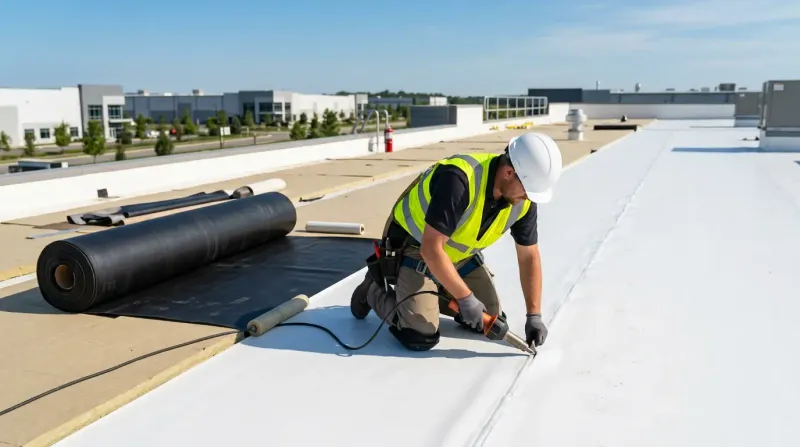
- Fully Adhered: The entire membrane is bonded to the substrate using adhesives, providing maximum wind uplift resistance
- Mechanically Attached: The membrane is secured with fasteners and plates along seam areas
- Ballasted: The membrane is loosely laid and held in place with ballast (typically stone)
- Hybrid Systems: Combining different attachment methods for optimized performance
Seaming Techniques
Proper seaming is critical to system integrity:
- TPO and PVC utilize hot-air welding, creating a molecular bond stronger than the membrane
- EPDM traditionally uses adhesive seaming methods, though newer systems may use tape systems
- All seams should be thoroughly inspected and tested during installation
- Proper overlap dimensions must be maintained throughout the installation
Flashing and Penetration Details
Roof penetrations can represent potential vulnerabilities if not properly addressed. If you’ve experienced chimney leaks or ceiling roof leaks in your current roofing system, these issues often stem from improper flashing details. Professional installation ensures that all penetrations receive appropriate flashing and waterproofing.
Upgrade Your Roof with Us
Selecting the right single-ply commercial roofing system requires careful consideration of your building’s specific needs, budget constraints, and performance priorities. But don’t worry, we can help you figure it out! Brandon J Roofing brings decades of commercial roofing expertise to every project, ensuring that your investment is protected with proper system selection and flawless installation.
Our team specializes in all three major single-ply systems and can help you navigate the decision-making process based on your building’s unique requirements. From detailed roof assessments to manufacturer-certified installation and comprehensive warranties, we delivercommercial flat roofing solutions engineered for long-term performance and value. Trust our experienced professionals for all your roofing services in St. Louis, including proper soffit fascia detail work that completes your roofing system.