Metal Building Insulation: Types, R-Values, and Investment Return
Metal buildings offer durability, versatility, and cost-effectiveness for commercial spaces, agricultural structures, and large workshops. However, without proper insulation for a metal building, these structures often become uncomfortably hot in summer, freezing in winter, and are plagued by condensation issues. Eventually, this creates significant thermal challenges, leading to excessive energy costs and potential structural damage.
Choosing the right insulation solution isn’t just about comfort—it’s about protecting your investment and peace of mind. Whether you’re planning a new construction or upgrading an existing structure, understanding insulation types, R-values, and return on investment is crucial. This guide will walk you through everything you need to know about insulation for metal building systems, helping you make informed decisions that balance upfront costs with long-term benefits.
Why Insulation is Essential for Metal Buildings
Metal conducts heat and cold extremely efficiently—a property that makes uninsulated steel buildings energy nightmares. Without proper insulation, your structure faces several critical issues:
Condensation Control
When warm, humid air comes into contact with cold metal surfaces, condensation forms. This moisture can:
- Drip onto equipment, inventory, or work areas
- Cause corrosion and rust on structural components
- Create perfect conditions for mold and mildew growth
- Deteriorate interior finishes and stored materials
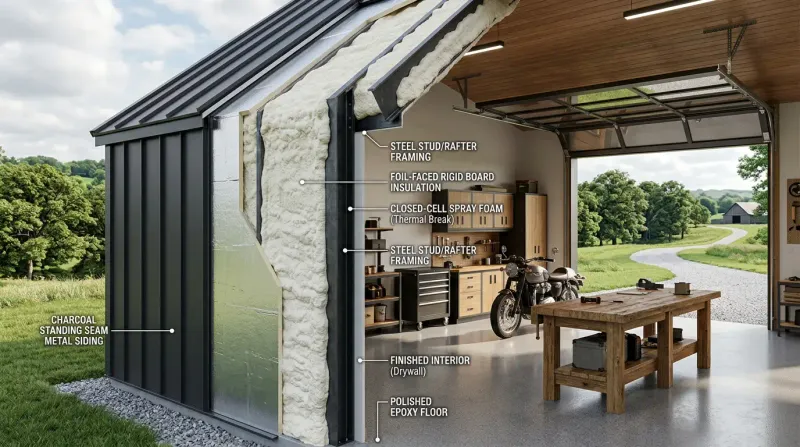
Properly insulating a metal garage roof system creates a thermal barrier that keeps interior surfaces above the dew point, preventing this damaging condensation.
Energy Efficiency
Uninsulated metal buildings can lose up to 70% of their heat in winter and absorb excessive heat in summer. This results in:
- Skyrocketing heating and cooling costs
- HVAC systems working beyond capacity
- Uncomfortable interior conditions
- Unnecessary environmental impact
Noise Reduction
Metal buildings naturally amplify sound. Quality insulation absorbs vibrations and reduces noise from:
- Rain and hail on metal roofing
- External environmental sounds
- Equipment operation inside the building
- Echo and reverberation of voices and activities
Common Challenges with Metal Building Insulation
Thermal Bridging
Metal structural elements create direct pathways for heat transfer between the interior and exterior environments. These thermal bridges occur at:
- Purlins and girts
- Fasteners and connection points
- Door and window frames
Effective metal building insulation installation must address these thermal bridges to create a complete thermal envelope.
Ventilation Balance
A properly vented metal roof system is crucial for long-term performance. The challenge lies in:
- Creating adequate airflow while maintaining thermal barriers
- Preventing moisture accumulation in insulation materials
- Balancing air exchange without compromising energy efficiency
- Designing systems appropriate for your climate zone
Space Constraints
Many metal buildings have thin walls and shallow rafters, limiting insulation options. Solutions must:
- Maximize R-value within available space
- Work around structural components
- Allow for proper fitting around utilities and penetrations
- Maintain required clearances for safety and functionality
Types of Metal Building Insulation Systems
Spray Foam Insulation
Closed-cell spray foam provides an airtight barrier with excellent thermal resistance.
Pros:
- Highest R-value per inch (R-6 to R-7)
- Creates a seamless air and vapor barrier
- Reinforces structural elements
- Fills gaps and irregular spaces perfectly
Cons:
- Higher initial investment
- Requires professional installation
- May require additional fire protection
Ideal for: Buildings requiring maximum efficiency, structures with irregular framing, and spaces where moisture control is critical.
Fiberglass Insulation
Traditional rolled or batt insulation remains popular for insulating a metal garage roof due to its cost-effectiveness.
Pros:
- Budget-friendly option
- Widely available materials
- Relatively easy installation
- Good sound absorption properties
Cons:
- Susceptible to moisture damage
- Requires facing as a vapor barrier
- Compression reduces effectiveness
- Thermal bridging remains a concern
Ideal for: Basic insulation needs, budget-conscious projects, and buildings in moderate climates.
Rigid Board Insulation
Polyisocyanurate, extruded polystyrene, or mineral wool boards provide a consistent R-value.
Pros:
- Consistent thermal performance
- Excellent compressive strength
- Resistant to moisture
- Can be cut to precise dimensions
Cons:
- Installation more labor-intensive
- Requires sealing between panels
- Limited flexibility around obstacles
- Higher material cost than fiberglass
Ideal for: Projects requiring precise fitting, buildings with regular framing layouts, and areas needing higher compressive strength.
Reflective Insulation Systems
Radiant barriers reflect heat radiation rather than slowing conductive heat transfer.
Pros:
- Excellent for reducing summer heat gain
- Lightweight materials
- Can be combined with other systems
- Lower cost than many alternatives
Cons:
- Limited winter benefit
- Not effective for moisture control alone
- Requires air space to function properly
- Lower R-values than other options
Ideal for: Hot climates, insulating a metal carport, and as components of hybrid insulation systems.
Understanding R-Value Requirements for Metal Buildings
R-value measures resistance to heat flow—higher numbers mean better insulation. Required values vary dramatically depending on:
Climate Zone Considerations
The International Energy Conservation Code (IECC) divides the U.S. into climate zones with different insulation requirements:
Hot/Humid (Southern): R-25 to R-30
Mixed (Mid-Latitude): R-30 to R-38
Cold/Very Cold (Northern): R-38 to R-49
Building Use Factors
Your building’s purpose significantly impacts insulation needs:
- Conditioned spaces (heated and cooled) require higher R-values
- Heated-only spaces need moderate R-values
- Unconditioned spaces may need minimal insulation focused on condensation control
- Cold storage facilities require specialized systems to prevent vapor migration
Total Building Envelope Strategy
Effective insulation works as part of a complete building envelope system that includes:
- Proper roof insulation and ventilation
- Air barriers to prevent infiltration
- Vapor barriers positioned according to the climate
- Strategic placement of doors, windows, and other penetrations
Optimizing Metal Building Insulation Installation
The effectiveness of any insulation system depends largely on proper installation. Key considerations include:
Professional vs. DIY Installation
While metal building insulation installation can be a DIY project for smaller structures, commercial buildings benefit from professional installation due to:
- Complex detail management at penetrations and transitions
- Specialized equipment for spray foam and difficult-to-reach areas
- Knowledge of building code requirements
- Warranty protection from manufacturer-certified installers
Installation Timing and Sequencing
For new construction, consider:
- Installing roof insulation before interior finish materials
- Coordinating with electrical, plumbing, and HVAC contractors
- Insulating before interior walls are finished
- Planning for future access to junction boxes and utilities
For retrofits, plan around:
- Business operation disruptions
- Weather conditions during installation
- Access to all building areas
- Potential need for temporary protection of contents
Roof-Specific Considerations
When insulating a metal carport or commercial structure, special attention must be paid to:
- Proper handling of ridge vents and eave ventilation
- Integration with vented metal roof designs
- Water drainage patterns and potential ponding areas
- Interface between roof and wall insulation systems
- Compatibility with standing seam vs. R-panel roofing systems
Calculating ROI and Payback Period
Making the business case for insulation requires understanding both costs and returns:
Initial Investment Factors
The upfront costs include:
- Materials (varies widely by type)
- Professional installation labor
- Potential structural modifications
- Permitting and code compliance
For most commercial buildings, expect $1-$5 per square foot for basic fiberglass systems and $3-$10 per square foot for premium spray foam solutions.
Energy Savings Calculations
Annual savings depend on:
- Local energy costs (electricity and gas rates)
- Climate severity (heating/cooling degree days)
- Building size and orientation
- HVAC system efficiency
- Hours of operation and use patterns
Most properly insulated metal buildings see 20-50% reductions in heating and cooling costs.
Payback Timeline
To calculate your payback period:
- Determine the total insulation project cost
- Estimate annual energy savings
- Divide the project cost by the annual savings
Example: A 5,000 sq ft metal building with a $20,000 insulation upgrade might save $4,000 annually in energy costs, creating a 5-year payback period.
You can expect more benefits beyond pure energy savings, including:
- Increased property value
- Extended building lifespan
- Reduced HVAC maintenance needs
- Improved occupant comfort and productivity
- Potential tax incentives or rebates
- Enhanced environmental responsibility
Quality Insulation That Shields Your Home
Investing in proper insulation for a metal building is a must. From preserving your structure through condensation control to creating comfortable, functional spaces for work or storage, quality insulation is essential for any metal building owner. The right system depends on your specific building design, climate conditions, and budget constraints. Still, even basic insulation vastly outperforms uninsulated metal structures.
Brandon J Roofing provides comprehensive commercial roofing solutions, including expert consultation on insulated metal roofs. Our experienced team can help you navigate options for insulating a metal carport, garage, or commercial facility with solutions tailored to your specific needs and budget. Don’t let your metal building waste energy and create uncomfortable conditions—invest in proper insulation that pays dividends for decades to come.