
Measure Your Metal Roof Accurately: Calculating Pitch, Panel Length, and Trim Needs
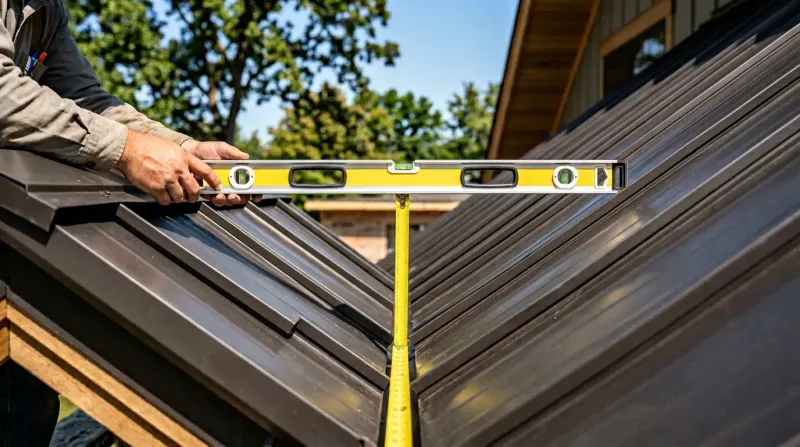
Accurate measurements are the foundation of a successful metal roof installation. Many homeowners face significant challenges determining exactly how much roofing material they need, often resulting in costly overages or frustrating shortages. Incorrect measurements can lead to project delays, budget overruns, and even compromise the integrity of your new roof.
In this comprehensive guide, you’ll learn the step-by-step process for measuring your roof for metal panels, calculating the pitch, determining trim requirements, and accounting for waste. Whether you’re planning a DIY installation or preparing to work with professionals, these how-to-measure-for-metal-roofing techniques will help you better understand your roofing project and potentially save you thousands of dollars.
Essential Tools and Safety Precautions for Roof Measurements
Before climbing onto your roof, proper preparation is essential for both accurate measurements and personal safety.
Required Tools
- Tape measure (25-foot minimum)
- Ladder of appropriate height
- Chalk line
- Level (2-foot recommended)
- Carpenter’s square
- Notebook and pencil
- Digital camera or smartphone
- Safety harness
- Non-slip shoes
Safety First
Working on a roof is inherently dangerous. Always have a spotter holding the ladder, wear non-slip footwear, and consider using a safety harness. Never measure your roof during wet, windy, or icy conditions. If your roof has a steep pitch or you’re uncomfortable with heights, it’s best to contact a professional for a roof measurement service.
When in doubt about safety, remember that a professional roof measurement is often offered for free by many roofing companies, including Brandon J Roofing.
Understanding Roof Squares and Square Footage
What Is a Roofing Square?
One of the most common terms you’ll encounter is “square.” What is a square for roofing? Simply put, a roofing square equals 100 square feet of roof area. This standard measurement is used throughout the industry to calculate materials.
What is a square for roofing may seem like a basic concept, but understanding it is essential for accurate material ordering. When contractors ask “ how many squares is my roof,” they’re determining how much material to order.
Calculating Total Roof Area
- Measure the length and width of each rectangular section
- Multiply length by width to get square footage
- For triangular sections, multiply the base by the height and divide by two
- Add all sections together for the total square footage
- Divide by 100 to convert to roofing squares
Learning how to measure a roof in squares is fundamental to any roofing project. The process requires careful attention to detail and proper technique for accurate results. A roof square calculator can simplify this process, especially for complex roof designs.
Online Calculators and Tools
Today’s technology offers convenient alternatives to manual measurements. A roof calculator by address uses satellite imagery to estimate your roof’s dimensions. These tools can provide a good starting point, but they’re not always 100% accurate.
The roof calculator by address technology, while convenient, should be verified with physical measurements for critical dimensions. Ourroof calculator square footage tool andGoogle Maps roof square footage calculator resources can help you get started. These roof square footage calculator tools make the initial estimation process much simpler.
Determining Your Roof’s Pitch
What Is Roof Pitch?
Roof pitch is the slope of your roof expressed as a ratio of vertical rise to horizontal run. Understanding how to determine the roof pitch is crucial for metal roofing, as it affects panel selection, installation methods, and water drainage.
Measuring Pitch From Inside
To determine how to figure out the pitch of the roof from your attic:
- Place a level horizontally against a rafter
- Measure 12 inches along the level from the rafter
- Measure vertically from the level to the rafter at that 12-inch mark
- The vertical measurement in inches is your roof pitch (e.g., 6-in-12)
Measuring Pitch From Outside
If attic access isn’t available:
- Place a level against the roof slope
- Adjust until the bubble is centered
- Measure 12 inches horizontally along the level
- Measure vertically from the roof surface to the level at that point
- The vertical measurement gives you the pitch ratio
Different metal roofing systems have minimum pitch requirements, so knowing your exact pitch is essential when selecting materials.
Measuring Panel Length for Metal Roofing
Basic Measurements
Learning how to measure for metal roofing panels starts with ridge-to-eave measurements. From the roof’s peak to the edge, measure straight down the slope (not horizontally). Take multiple measurements as the length can vary across the roof.
Accurately measuring metal roofing requires accounting for overhangs. Typically, metal panels should overhang the eave by 1-2 inches to ensure proper water runoff into gutters. The process requires understanding both the physical structure and the specific requirements of metal panel systems.
Accounting for Ridge Caps and Eaves
When measuring panel length:
- Measure from peak to edge along the slope
- Add overhang allowance (typically 1-2 inches)
- Subtract any ridge cap overlap (usually 3-4 inches)
- Round up to the nearest standard panel length
Panel Width Considerations
Standard metal roofing panels come in various widths, typically 24-36 inches, with coverage. When calculating how many panels you need:
- Measure the width of each roof section
- Divide by the coverage width of your selected panel
- Round up to the nearest whole number
- Add additional panels for complex cuts around vents and chimneys
Calculating Trim and Flashing Requirements
Types of Trim Needed
Metal roofing systems require various trim pieces for a complete installation:
- Ridge caps
- Gable/rake trim
- Eave trim
- Valley flashing
- Sidewall and endwall flashing
- Transition flashing
Measuring for Trim
For ridge caps:
- Measure the length of all roof ridges
- Add 6 inches for overlaps at joints
- Add extra for corners or intersections
For rake/gable trim:
- Measure from eave to peak along the roof edge
- Multiply by 2 for both sides
- Add 5% for overlaps
For eave trim:
- Measure the perimeter of your roof’s bottom edge
- Add 5% for overlaps and corners
Flashing Requirements
Proper flashing is critical for a watertight installation. Measure around all roof penetrations:
- Chimneys (all four sides plus 6 inches)
- Skylights (perimeter plus 6 inches)
- Roof/wall intersections (full length plus 6 inches)
- Valleys (length plus 12 inches)
Accounting for Waste and Extra Materials
Standard Waste Factors
Every roofing project generates waste from cuts, overlaps, and adjustments. When ordering materials:
- Add 5-10% to panel calculations
- Add 10-15% for complex roof designs
- Add 10% for trim pieces
When to Order Extra
Certain situations warrant additional material:
- Unusual roof features requiring special cuts
- Multiple valleys or dormers
- First-time DIY installation
- A remote location where additional material would be difficult to obtain
Cost vs. Risk Considerations
While ordering excess material increases upfront costs, running short can result in:
- Project delays
- Color matching issues with new batches
- Additional shipping expenses
- Installation compromises
For roof-shingle-measurement calculator needs, the principles are similar, but the waste factors may differ. Our guide onshingles roofing provides more specific information for asphalt shingles. Using a shingles calculator can help you determine material needs, but the same waste factor principles apply whether you’re installing metal or asphalt.
Get Precise Results with Brandon J Roofing
Accurate measurements are the cornerstone of a successful metal roofing project. By properly calculating your roof square footage and understanding your specific requirements, you can avoid costly mistakes and ensure your installation proceeds smoothly. Utilizing a reliable roof square footage calculator can significantly improve your estimation accuracy. And getting professional assistance is even better!
At Brandon J Roofing, we understand that even small measurement errors can lead to significant problems during installation. Learning how to measure a roof in squares is a skill that pays dividends throughout your roofing project. That’s why we offer professional measurement services as part of our comprehensiveroof replacement service. Our experienced team can provide precise calculations for your metal roofing needs, from panels to trim pieces, and evenassist with gutter size calculations. Don’t risk costly mistakes – let our experts ensure your project starts with the right foundation.