How to Calculate Roof Square Footage: A Complete Guide for Accurate Quotes
Calculating the correct square footage of your roof is a crucial first step for any roofing project. Whether you’re planning a repair, a roof replacement, or a brand new installation, inaccurate measurements can lead to ordering too much material (wasting money) or too little (delaying your project). But don’t worry, we can help you figure it out.
In this comprehensive guide, we’ll walk you through proven methods to calculate yourroof’s square footage accurately. You’ll learn the difference between ground measurements and pitch-adjusted calculations, understand how to convert measurements into roofing squares, and avoid common estimation mistakes. Let’s dive into it!
Understanding Roofing Measurements and Terminology
What is a Roofing Square?
Before diving into calculations, it’s essential to understand the industry terminology. In roofing, contractors don’t typically talk in terms of square feet—they use “squares.” 1 square roofing equals 100 square feet of roof area. This standardized unit makes ordering materials more straightforward, since most roofing materials are sold by the square foot.
For example, if your roof measures 2,000 square feet, a contractor would say you have a 20-square roof. This terminology originated to simplify communications and estimates in the roofing industry. When you understand that 1 square roofing equals 100 square feet, you can easily convert between the two measurements.
Roofing Materials and Coverage
Different roofing materials have varying coverage rates:
- Asphalt shingles: Typically, three bundles cover one square
- Metal roofing: Usually sold in panels calculated by the square foot
- Tile or slate: Often requires more material per square due to overlap
Understanding these coverage rates is crucial when determining the shingles needed for your project. Most manufacturers provide specific coverage information on their packaging.
Method 1: Ground-Level Measurement for Quick Estimates
Tools You’ll Need
To perform basic measurements, gather:
- Measuring tape (25ft minimum)
- Calculator
- Paper and pencil
- Ladder (optional for better visibility)
Step-by-Step Measurement Process
- Measure the length and width of each section of your house from the ground.
- Multiply length by width to get the footprint square footage.
- For a basic gable roof, multiply this number by 1.3 to account for the slope.
- For more complex roofs, measure each section separately and add them together.
Have you been wondering: “ How many square feet is my roof?” Let’s break it down. If your home’s footprint is 1,500 square feet and you have a typical gable roof, a quick calculation would be 1,500 × 1.3 = 1,950 square feet, or 19.5 roofing squares.
Accounting for Overhangs and Eaves
Don’t forget to include roof overhangs in your measurements. Measure from the outer edge to the outer edge of the eaves, not just the exterior walls of your home. Ignoring overhangs is one of the most common mistakes when calculating roof square footage.
Method 2: Using Roof Pitch for Greater Accuracy
Determining Your Roof’s Pitch
Roof pitch is expressed as a ratio, like 4:12, meaning the roof rises 4 inches for every 12 inches of horizontal run. To determine your roof’s pitch:
- Place a level against the roof rafters in your attic
- Measure 12 inches along the level
- Measure the vertical distance from the 12-inch mark to the roof surface
- This vertical distance is your roof’s rise
Once you know your roof’s pitch, use multipliers to convert your home’s footprint to actual roof calculator square footage. For example, if your house footprint is 1,500 square feet and you have a 6:12 pitch roof, your actual roof area would be 1,500 × 1.18 = 1,770 square feet, or 17.7 squares. This method provides a more accurate way to calculate the square footage of a roof than the first method.
Converting Measurements to Material Requirements
From Square Footage to Roofing Squares
Once you have your total square footage, convert it to roofing squares by dividing by 100:
Roofing Squares = Total Square Footage ÷ 100
Understanding what a roofing square (100 sq ft) is makes this conversion straightforward. For instance, a 2,400-square-foot roof would be 24 squares.
Estimating Shingle Requirements
To determine how many shingles you need, you must understand the coverage per bundle:
- Standard 3-tab shingles: 3 bundles typically cover 1 square
- Architectural or dimensional shingles : 3-5 bundles per square, depending on style
For example, if you have a 24-square roof and are using standard 3-tab shingles, you would need: 24 squares × 3 bundles = 72 bundles of shingles.
Most shingles per sq ft calculations can be simplified by using the square method. For standard shingles, you’re looking at approximately 3 bundles covering 100 square feet of roof area.
Add a Waste Factor
Always add 10-15% extra for waste, especially for complex roofs with many cuts. For a 24-square roof, you should order: 24 × 1.15 = 27.6 squares of material (round up to 28)
This waste factor is critical when using any shingle estimator, whether a calculator or a manual calculation method.
Using Digital Tools for Roof Estimation
Online Calculators and Their Benefits
Today, several online tools can help with roofing calculators. These tools allow you to input your roof’s dimensions and instantly get:
- Total square footage
- Required number of squares
- Estimated materials needed
- Approximate costs
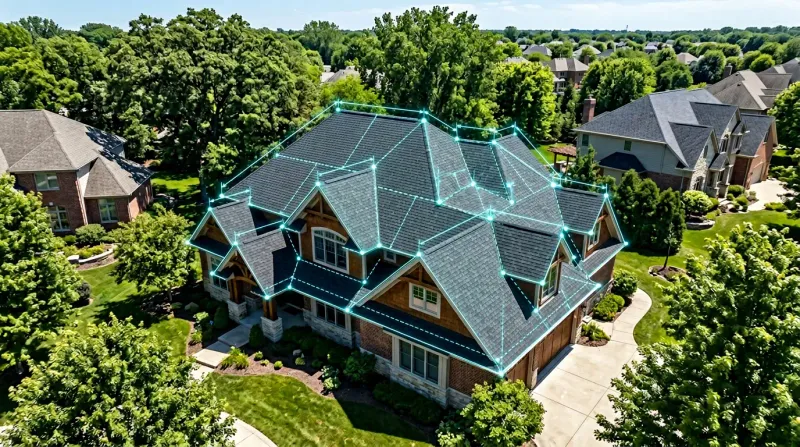
Manyonline measurement tools also allow you to measure your roof directly from satellite imagery, making it easier to determine how many square feet your roof is without climbing a ladder.
Professional Roof Measurement Reports
For the highest accuracy, professional roof measurement reports use aerial imagery and specialized software to provide:
- Precise measurements of all roof sections
- Detailed breakdowns of ridge, valley, and eave lengths
- Waste calculations
- Material lists
These reports eliminate guesswork when determining square roofing size for complex projects.
Common Measurement Mistakes to Avoid
Forgetting Architectural Features
When calculating roof square footage, don’t forget to include:
- Dormers
- Skylights (though you’ll subtract their area later)
- Chimneys
- Different roof levels
Miscalculating Pitch Factor
Using an incorrect pitch factor can significantly throw off your calculations. If you’re unsure about how to measure a square for roofing with the correct pitch factor, it’s always better to consult a professional roofer.
Ignoring Material-Specific Requirements
Different roofing materials have varying requirements. When wondering how to figure out how many shingles you need, consider these differences:
- Asphalt roofing has different coverage than dimensional roofing shingles
- Metal roofing requires specific calculations for panels and trim
Understanding Roofing Cost Calculations
The cost per square foot of roofing varies widely depending on:
- Material type
- Material quality
- Your location
- Labor costs
- Removal of old roofing (if applicable)
Nationally, you might see prices ranging from $100 to $1,500 per square foot, depending on these factors. When budgeting, accurate square roofing measurements are essential for reliable cost estimates.
Using a simple formula:
Total Project Cost = (Number of Squares × Cost per Square) + Additional Expenses
This calculation helps you understand the true cost per square foot of roofing and why accurate measurements are the foundation of any reliable roofing estimate.
Start Your Roofing Project with The Local Experts
Calculating your roof’s square footage doesn’t have to be intimidating. While DIY methods can give you a good starting point for figuring out the square footage of a roof, you can always count on the accuracy of a professional measurement. When you need precise roof measurement reports for your project, Brandon J Roofing is one call away.
With years of experience and countless finished projects, our team understands how to measure squares for roofing with precision. We can also detect potential issues that might not be visible from ground level, ensuring your home is in top shape. Ready to work with the pros?